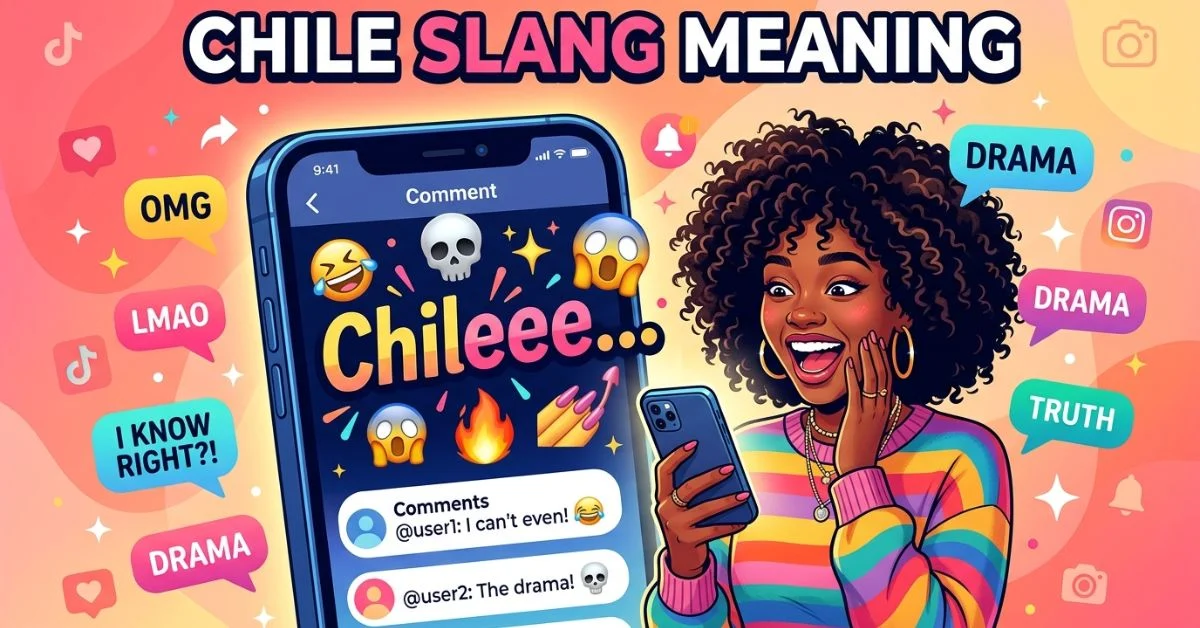
You’re scrolling through TikTok, laughing at a viral video, and suddenly you see a comment: “Chileeee…” You pause.
Is it about the country? A typo? Or something else entirely? That moment of confusion is exactly why so many people search for chile slang meaning every day.
I remember the first time I saw it—I thought someone misspelled “child.” But as I kept seeing it in memes, chats, and Instagram comments, it became clear that chile slang meaning had a totally different vibe.
It wasn’t just a word; it was a reaction, a mood, a whole expression.
If you’ve been wondering what it means, when to use it, and how to respond without sounding awkward, you’re in the right place. Let’s break it down in the simplest way possible.
Meaning & Definition
At its core, chile slang meaning refers to a playful, expressive version of the word “child.” But in modern internet language, it’s rarely used literally.
Instead, chile works as a reaction word. It’s used to express:
- Shock or disbelief
- Drama or gossip reactions
- Sarcasm
- Emotional exaggeration
For example:
- “Chile, what did I just hear?”
- “Chile, this is too much 😭”
The word often appears stretched out—like “chileeee”—to intensify the emotion. The longer it is, the stronger the reaction feels.
In simple terms, chile slang meaning is less about the word itself and more about the feeling behind it.
Background
The roots of chile slang meaning trace back to African American Vernacular English (AAVE), where pronunciation variations like “chile” instead of “child” are natural in spoken language.
Over time, this pronunciation made its way into digital spaces. Social media platforms like TikTok, Twitter (X), and Instagram played a huge role in spreading it globally.
Creators began using chile in captions, reaction videos, and memes. Its dramatic and humorous tone made it perfect for internet culture.
Soon, people from different backgrounds started using it in everyday online conversations.
Understanding this background is important because chile slang meaning isn’t just random internet slang—it has cultural origins that shaped its popularity.
Usage in Different Contexts (Chat, Social Media, Professional Fields)
Casual Chat
In texting, chile slang meaning shows up as a reaction starter or standalone comment:
- “Chile, you won’t believe this.”
It adds personality and makes messages feel more expressive.
Social Media
On platforms like TikTok and Instagram, it’s widely used in:
- Comments
- Captions
- Memes
Example:
- “Chile, this situation is wild 💀”
Professional Fields
In formal communication, chile slang meaning is not appropriate. Avoid using it in:
- Emails
- Work chats
- Reports
It’s strictly informal and best kept for casual conversations.
Meaning in Chat, WhatsApp, Instagram, TikTok
Chile slang meaning becomes even clearer when you see how it’s used across platforms:
- WhatsApp: Friendly, casual reactions between friends
- Instagram: Dramatic or funny comment responses
- TikTok: Reaction-based storytelling and humor
Example:
- “Chile, the ending shocked me 😳”
On TikTok especially, it often reflects exaggerated emotions, making content more entertaining and relatable.
Meaning in Physics, Medical, and Aircraft Terminology
To avoid confusion, it’s important to clarify that chile slang meaning has no relevance in technical fields.
- Physics: No defined meaning
- Medical field: Not used as a term
- Aircraft/Aviation: No connection
If you see “Chile” in these areas, it almost always refers to the country—not slang.
Common Misconceptions
There are several misunderstandings about chile slang meaning:
- It refers to the country Chile
- It’s just a spelling mistake
- It always means “child” literally
In reality, it’s an intentional slang expression used for emotional reactions.
Similar Terms & Alternatives
If you want similar expressions, here are some alternatives:
- “Girl…”
- “Bro…”
- “I can’t…”
- “Seriously?”
- “Wow…”
While these share similar meanings, chile slang meaning stands out because of its dramatic and humorous tone.
How to Respond to It
Responding to chile slang meaning depends on the context:
- Shock or drama:
→ “Right?! That’s crazy!” - Sarcasm:
→ “I’m done 😂” - Gossip:
→ “Tell me everything!”
The key is matching the tone. Keep it light, casual, and expressive.
Differences from Similar Words
Understanding differences helps you use it correctly:
- Chile vs Child:
“Child” is literal; chile slang meaning is expressive - Chile vs Girl/Boy:
“Girl” addresses someone; “chile” reacts to a situation - Chile vs Bro:
“Bro” is neutral; “chile” is dramatic and playful
Relevance in Online Conversations & Dating Apps
In today’s digital world, chile slang meaning plays a role in making conversations more human and expressive.
On social media and dating apps, it’s used to:
- React to funny or shocking messages
- Add humor to conversations
- Keep chats engaging
Example:
- “Chile, you really said that? 😂”
However, it should be used carefully in serious conversations to avoid sounding unserious.
FAQs
1. What does chile mean in slang?
It’s a playful reaction word used to express shock, humor, or disbelief, not the literal word “child.”
2. Is chile slang rude?
No, it’s not rude. It’s usually humorous and lighthearted, depending on the tone.
3. Why do people say chile instead of child?
It comes from AAVE pronunciation and became popular through social media.
4. Can I use chile in formal writing?
No, it’s informal slang and should be avoided in professional settings.
5. Is chile the same as the country Chile?
No, the slang meaning is completely different from the country name.
Conclusion
By now, chile slang meaning should feel much clearer. What once looked confusing is actually a simple, expressive way to react online.
Whether it’s shock, sarcasm, or just playful drama, this slang adds personality to conversations.
Its journey from AAVE to global internet culture shows how language evolves quickly in the digital age. Today, you’ll see it everywhere—from TikTok comments to casual chats with friends.
Just remember: use it in the right context, keep it natural, and don’t overdo it. When used correctly, it can make your conversations feel more fun, relatable, and alive.